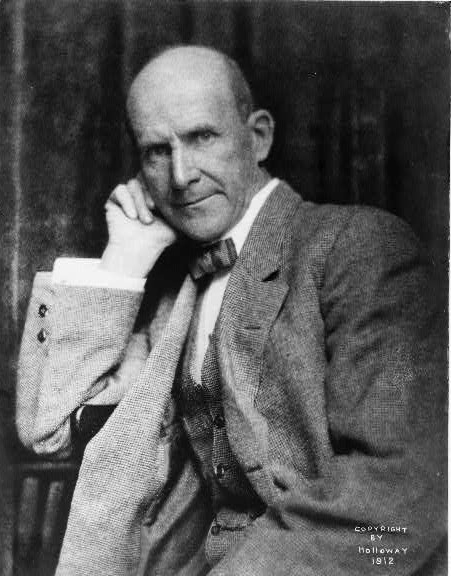
Bill Haywood

Biography
Bill Haywood was the founding general secretary-treasurer of the Industrial Workers of the World (IWW, the Wobblies) and one of the most important figures in U.S. radical labor history. A one-eyed former Western miner, he led the Western Federation of Miners and was acquitted in the 1907 Steunenberg murder trial, defended by Clarence Darrow. In September 1917 federal agents raided IWW offices across the country and arrested its leaders; the resulting mass federal trial in Chicago — United States v. Haywood et al., before Judge Kenesaw Mountain Landis — was the largest political prosecution in U.S. history at that point. After a four-month trial, on August 17, 1918, the jury convicted 101 of the 113 IWW defendants, and Haywood was sentenced on August 30, 1918 to twenty years in federal prison and a $20,000 fine. Released on bond from Leavenworth on July 28, 1919, Haywood remained free pending appeal. In March 1921, Haywood jumped bail and fled to Soviet Russia, where he died on May 18, 1928; his ashes were divided between the Kremlin Wall Necropolis in Moscow and the Haymarket Martyrs Monument in Forest Park, Illinois. (Recorded as William Dudley "Big Bill" Haywood)
Daily Worker, February 21, 1935, page 5: Michael Gold recalls a Colorado strike leaflet in which Haywood used an American-flag design to denounce martial law, suspension of habeas corpus, restrictions on speech, arrests and expulsion of union members. The column says troops removed it from public walls. This is an attributed recollection of his labor advocacy, with no exact year or new personal detention established.
Daily Worker, November 3, 1928, page 1, 3, 7: Memorial reports describe the requested division of his ashes between Moscow and the Haymarket graves near Chicago, with New York arrival expected November 7 and Chicago observances planned November 11. Those are prospective memorial dates, not new custody endpoints. The retrospective recalls the Moyer–Pettibone trial, Lawrence strike and twenty-year federal IWW sentence. The issue inconsistently places his Soviet departure in 1920 and 1921, so no existing chronology is overwritten. Its identified portrait is retained; existing photo preserved. Source: https://www.marxists.org/history/usa/pubs/dailyworker/1928/1928-ny/v05-n261-NY-nov-03-1928-DW-LOC.pdf
Daily Worker, July 22, 1929, page 5: Vern Smith’s historical article recalls the February 1906 Denver arrests and removal to Idaho without extradition, the 1907 proceedings before Judge Woods, William Borah’s prosecution, Clarence Darrow’s defense, Harry Orchard’s testimony and the mass defense movement. Its collective statement that all three were acquitted compresses their distinct procedural outcomes; it does not replace individual case records or provide new exact arrest/release dates. Source: https://www.marxists.org/history/usa/pubs/dailyworker/1929/1929-ny/v06-n116-NY-jul-22-1929-DW-LOC.pdf
The autobiographical account describes actual September 28, 1917 arrest, the Federal Building and Cook County Jail before the Chicago IWW trial. This is pretrial custody within the existing federal prosecution, not an additional prosecution or a replacement for the independently documented September 1918 Leavenworth receipt and July 1919 bail release. Source: https://www.marxists.org/history/usa/pubs/dailyworker/1929/1929-ny/v06-n044-NY-apr-26-1929-DW-LOC.pdf#page=6
A May 15 Moscow dispatch published May 16 reports Haywood’s relapse after being moved from Kremlin Hospital to his home at the Lux Hotel. It describes diabetes treated with insulin, heart weakness and a cancelled planned trip to Nacesta in the Caucasus. These are contemporary final-illness details during his Soviet exile; the planned trip is not evidence of actual movement or a custody endpoint. Source: https://www.marxists.org/history/usa/pubs/dailyworker/1928/1928-ny/v05-n115-NY-may-16-1928-DW-LOC.pdf#page=1
1920s custody-date review: Original Leavenworth record sheets identify William D. Haywood, inmate 13106: Chicago arrest September 28, 1917; penitentiary receipt September 7, 1918; bond release July 28, 1919. These replace the conflicting arrest, admission and release dates. The earlier Idaho case is unchanged. No continuous imprisonment through the 1921 departure is asserted.
Sources: National Archives, William Haywood inmate file, scans 003 and 005; National Archives Foundation DocsTeach record-sheet description.
1920s duration reconciliation: The source-supported interval 1918-09-07 through 1919-07-28 computes to 324 elapsed days (end minus start). This is the specific documented custody episode, not necessarily lifetime custody; earlier or later unquantified detention is excluded. NARA original inmate13106 receipt September7,1918 and bond release July28,1919.324days valid; revised case falls outside decade inventory and must not be restored from stale initial snapshot. The previously blank audit expectation was superseded by this explicit evidence-based calculation; no event dates are changed here.
Daily Worker, November 3, 1928; relevant page stated in the accompanying profile note.
Daily Worker, July 22, 1929; relevant page stated in the accompanying profile note.
In his signed “Break the Conspiracy” account, Wm. D. Haywood describes leaving Leavenworth on $15,000 bond after eleven months of a twenty-year sentence and a $20,000 fine. Eleven months describes his Leavenworth segment, not all earlier pretrial custody; the independently established original-record dates and documented 324-day interval remain unchanged. The issue also prints William D. Haywood in its Lawrence strike history.
White identifies a separate1913 Paterson strike conviction and actual jailing for disorderly conduct. The cited newspaper headline refers to a nominal six-month sentence; the article does not establish exact admission, discharge or full time served.
The secretary’s convention report says the general defense committee was organized after Haywood’s release from Leavenworth, and his appointment was ratified at the August board meeting. This supports the established bail-release history; it is not a new May 1920 release or completion of sentence.
The One Big Union Monthly, June 1920, vol. 2 no. 6, PDF page 54.
The January 1920 Chicago conspiracy roster names him among the apprehended defendants bailed out in January–February, with the case subsequently postponed. This is distinct from the 1918 federal Espionage Act conviction and its appeal bail; no exact new arrest or release day or final verdict is supplied.
The One Big Union Monthly, May 1920, vol. 2 no. 5, PDF page 60.