
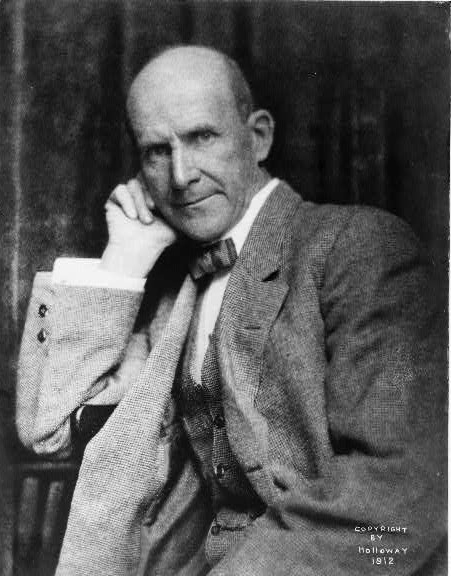
Biography
Eugene Debs was the foremost American socialist of his era — locomotive fireman, founder of the American Railway Union (1893), leader of the 1894 Pullman Strike, IWW co-founder (1905), five-time Socialist presidential candidate. On June 16, 1918 he delivered an anti-war speech in Canton, Ohio condemning U.S. involvement in WWI; convicted under the Espionage Act on Sept 12, 1918 and sentenced to 10 years. Served at Moundsville (WV) and Atlanta Federal Penitentiary, where in 1920 he received nearly 920, 000 votes for president as "Convict No. 9653." Harding commuted his sentence to time served on Dec 23, 1921; he walked out of Atlanta on Christmas Day. Died Oct 20, 1926 of cardiovascular disease aggravated by imprisonment. Eugene Victor Debs was the most prominent socialist in U.S. history — five-time Socialist Party of America presidential candidate, founder of the American Railway Union (which led the 1894 Pullman Strike, for which Debs served six months at the Woodstock IL jail), and co-founder of the Industrial Workers of the World in 1905. On June 16, 1918, in Canton, Ohio, Debs delivered a public speech denouncing U.S. participation in World War I and the prosecution of socialist anti-war organizers. He was arrested two weeks later under the Espionage Act of 1917, convicted September 12, 1918 in federal court in Cleveland, and sentenced to ten years in federal prison. He began serving in April 1919 at the West Virginia State Penitentiary in Moundsville, then was transferred to the United States Penitentiary in Atlanta. From his cell as Federal Prisoner #9653, Debs ran for president of the United States in 1920 on the Socialist Party ticket and received 919, 799 votes — nearly one million Americans voting for a presidential candidate then in federal prison. President Warren G. Harding commuted Debs's sentence to time served on Christmas Day 1921; Debs was released December 25, 1921 after serving roughly two and a half years. Eugene Debs was a leading figure in the American labor movement
The supplement reproduces Debs’s June 16, 1918 Canton antiwar speech, with an editorial footnote naming the three imprisoned socialists he had visited. Page 9 also reprints his greeting on the Russian Revolution, expressly marked written in Atlanta Federal Penitentiary and published November 7, 1920. This is prison-authorship evidence and political context, not a new admission or inferred continuous total. Source: https://www.marxists.org/history/usa/pubs/dailyworker/1931/v08-n052-NY-sect-one-feb-28-1931-DW-LOC.pdf#page=9
Joseph M. Coldwell's signed account on printed pages 10-11 (PDF page 10) places Debs in Atlanta penitentiary on May Day 1921, standing near Nicholas Zogg during an inmates' labor-song observance. It contrasts Debs's antiwar prosecution with three unnamed Russian prisoners jailed for leaflets opposing intervention against Soviet Russia. The Russian prisoners' identities are not guessed. No new sentence or custody endpoint is established. Source: https://www.marxists.org/history/usa/pubs/socialist-call/v1n06-apr-27-1935.pdf
Edward Levinson's page 4 article on the Norris–LaGuardia law retrospectively discusses the federal injunction and government repression of the American Railway Union during the Pullman strike under Debs' leadership. This is historical labor-injunction context, without a newly documented personal arrest, sentence or custody endpoint. Source: https://www.marxists.org/history/usa/pubs/new-leader/1932/v13n14-apr-02-1932-NL.pdf
Printed page 27 (PDF page 11) identifies Eugene V. Debs among subscribers supporting the Russian-American Industrial Corporation, established through the Amalgamated Clothing Workers. This supplies contemporary 1923 solidarity context, not additional prosecution or custody. Source: https://www.marxists.org/history/usa/pubs/srp/v8n02-feb-1923-sov-rus-pict.pdf
The September 1919 Liberator describes Debs working in the Atlanta penitentiary clothing shop from eight until noon and from one until 3:45, with only twenty minutes in the yard before supper and confinement in his cell from five in the evening until seven the next morning. The editorial protested the heat and the resulting strain on the imprisoned socialist. Source: https://www.marxists.org/history/usa/culture/pubs/liberator/1919/09/v2n09-w19-sep-1919-liberator.pdf#page=5
Pages 4 and 10 recall imprisonment over his June 16, 1918 Canton anti-war speech and reproduce excerpts from his address to the sentencing jury. The latter introduces a ten-year imposed term; this is the nominal sentence, not actual ten years served. The contemporary reprint documents his anti-war defense and internationalist position without a new custody episode.
The New Leader, April 2, 1932; relevant page stated in the accompanying profile note.
Soviet Russia Pictorial, February 1923; relevant page stated in the accompanying profile note.
The Justice Department conviction table in the 1921 Senate hearings lists E. V. Debs in the Northern District of Ohio, with a ten-year Espionage Act sentence dated September 14, 1918, and reports him still in the penitentiary. This printed date differs from the September 13 sentencing date in this database; the discrepancy is preserved without replacing that date or inferring a new admission or release. Palmer's January 19 testimony says he would not say Debs would be excluded from executive relief, while Albert De Silver's January 5 letter describes a Christmas presidential refusal based on lack of repentance. These are attributed statements in the hearing record, not a newly established clemency action.
Amnesty and Pardon for Political Prisoners, physical PDF pages 91,102,204 (printed85,96,198); SHA256 78ef2e71d40cc5d7a3e9ce8e3a10aa5c745c70cd879bc33cbba1b11d02482441. 1921 Senate hearings.
The September 1919 Liberator describes Debs working in the Atlanta penitentiary clothing shop from eight until noon and from one until 3:45, with only twenty minutes in the yard before supper and confinement in his cell from five in the evening until seven the next morning. The editorial protested the heat and the resulting strain on the imprisoned socialist.


