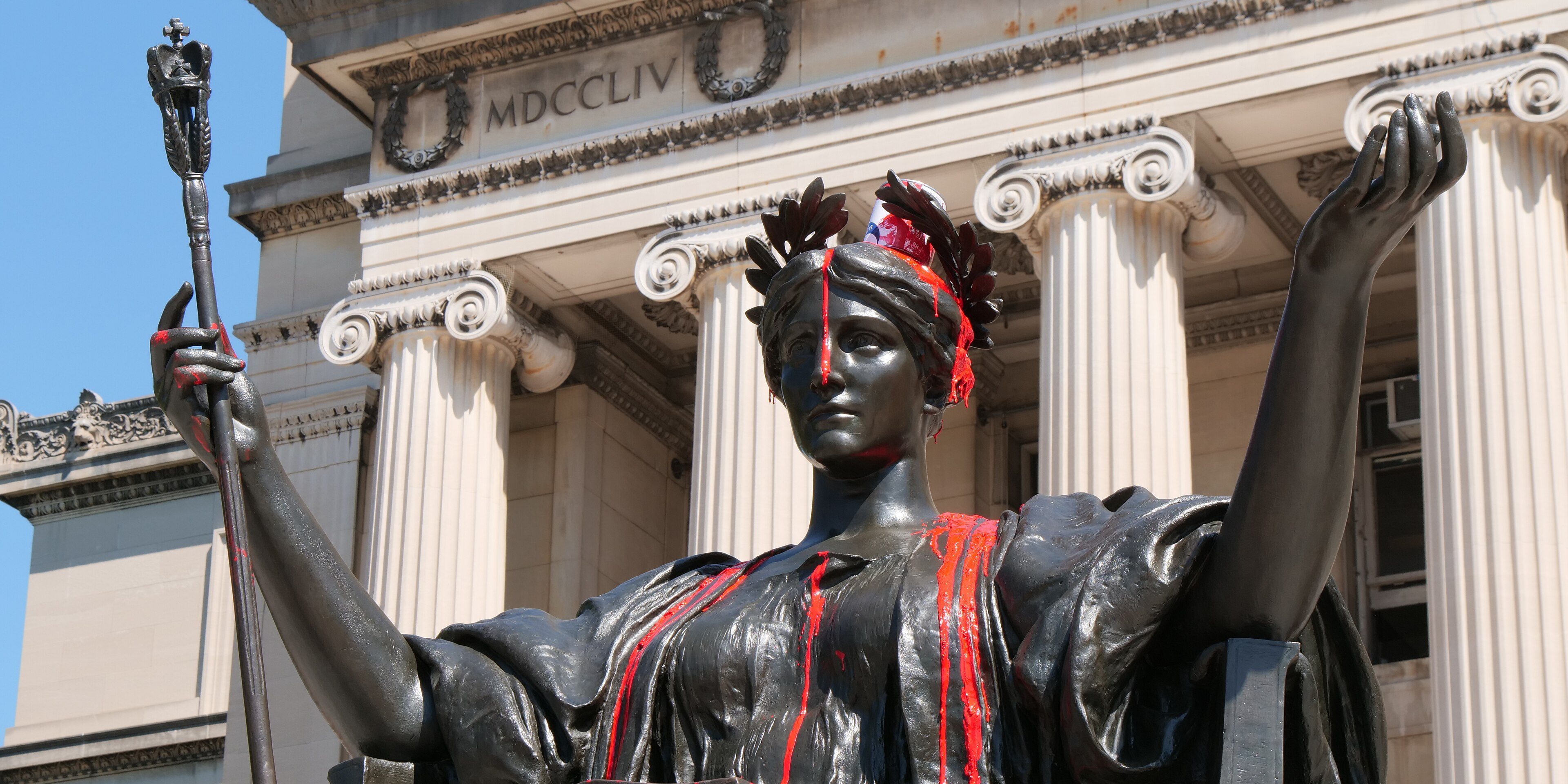

A protester poured red paint over Columbia University's Alma Mater statue. The paint was gone by the end of the day. The police investigation continued for months, drawing on 21 camera views, more than two hours of continuous movement tracking and facial-recognition software to identify one person.
That surveillance trail appears in discovery records obtained by The Intercept. The records show how New York City police reconstructed a masked protester's movements across and beyond Columbia's campus after a September 3, 2024 protest against Israel's war in Gaza.
The investigation eventually led Manhattan prosecutors to charge Jakhi McCray, also identified in court records as Jakhi Isaiah, over the paint action. The records do not establish that facial recognition alone proved who committed the act. They show that a facial-recognition result became a key investigative lead after police used camera networks to follow the person to a location where a mask came off.
A two-hour trail across 21 camera views
Columbia resumed fall classes on September 3, 2024, months after the university called police onto campus to clear a pro-Palestinian encampment and Hamilton Hall. During a new demonstration that morning, a person splattered the bronze Alma Mater statue with red paint. Contemporary coverage described the act as part of a protest demanding divestment from Israel. Columbia said the statue sustained thousands of dollars in damage, although the paint was removed that day.
According to the discovery material reviewed by The Intercept, detectives assembled footage from 21 camera angles. They tracked the alleged subject for more than two continuous hours, on and off campus. The person wore a mask and hat, entered a building and changed clothes. Investigators continued following the route until a nearby street camera captured a face without the mask.
The NYPD then submitted an image to its facial-recognition system and received a possible match. Department policy describes facial-recognition results as investigative leads rather than positive identifications. Detectives used the result with the camera trail and other evidence, and the department issued a notice stating that probable cause existed to arrest McCray.
The scale of the search matters because the alleged conduct was visible, brief and nonviolent. A single political act became the basis for joining numerous camera feeds into a continuous record of a person's movements well after the paint was thrown.
Columbia first asked police to stop
The records also show uncertainty inside Columbia about whether to pursue the case. University officials initially asked the NYPD to terminate the investigation, then reversed that request within a day and described the first instruction as a miscommunication.
Months later, officers arrested McCray at an unrelated anti-ICE demonstration. Police did not charge him over the Columbia incident at that time. The paint case returned after federal authorities began a separate investigation into the June 12, 2025 burning of ten NYPD vehicles and a trailer in a secured Bushwick lot.
Those are separate cases and should not be collapsed into one allegation. Federal prosecutors accused McCray of entering the lot and setting the vehicles on fire. He surrendered after a manhunt and later pleaded guilty to one federal arson count. Manhattan prosecutors filed the Columbia paint charges after he was in federal custody. The Justice Department's plea announcement addresses the Bushwick fire; it does not prove who threw paint at Columbia.
Surveillance built around political dissent
The Columbia records offer a concrete view of how ordinary surveillance infrastructure can be combined. A person did not need to remain in front of one camera or present an unobstructed face at the protest. Investigators moved from one feed to the next, carried the trail across public space, followed a clothing change and waited for a later image that could be searched.
The same records say an NYPD report connected to McCray's arraignment listed 41 “associates,” including people suspected of being contacts or previously arrested with him at protests. Inclusion on such a list is not evidence of criminal conduct. In the context of an investigation originating with political protest, however, it shows how a case focused on one person can produce a wider map of activists and associations.
Facial recognition can accelerate that expansion. A camera trail supplies a face; the software supplies a candidate; police records and protest-arrest histories supply a network. Each step may be described as an investigative technique, but together they allow a minor property allegation to become an extensive inquiry into movement and association.
What the case establishes
The documents do not show that everyone attending a Columbia protest was identified, or that facial recognition by itself determined the outcome of the case. They establish a narrower and still consequential fact: after a pro-Palestinian protest involving washable paint, the NYPD devoted the capacity of at least 21 camera views and facial-recognition technology to finding a suspect.
That record shifts the debate about protest surveillance from possibility to practice. New York's cameras were not merely collecting footage in the background. Investigators used them to reconstruct hours of movement beyond the scene, overcome a mask and a clothing change, and generate a face for automated comparison.
The legal cases will determine responsibility for the charged conduct. The surveillance record already answers a different question: how far police were prepared to follow political dissent after the visible protest had ended.