
Abstract: DeKalb County, Georgia has been mired in a struggle to defend its forest against the development of a militarised police training facility known as “Cop City”. Drawing on autoethnographic research as a criminalised forest defender and the Stop Cop City movement’s social history, I show how forest defenders created abolitionist possibilities beyond policing and prisons within two spaces of struggle: the Weelaunee forest, where forest defenders built and fought for a life-affirming, cop-free ecosystem; and inside Georgia’s jails, where forest defenders incarcerated for alleged participation in the struggle built solidarity and fought for collective survival. The movement’s strategy of “building and fighting” using insurrectionary, autonomous, and procedural abolitionist tactics has accomplished what abolition geographers call the radical place-making of abolitionist life-worlds. Wielding eco-defence and disruptive protest while prefiguring worlds where criminalised people and communities prevail even in the deadliest of places, forest defenders have undermined carceral state power.
Keywords: abolition geographies, carceral state, necropolitics, policing, Stop Cop City, protest
Introduction
On 18 January 2023, police killed an environmental activist and land defender named Tortuguita.
Tortuguita had been occupying the Weelaunee forest in DeKalb County, Georgia when Georgia State Patrol officers murdered them in the midst of a multi-agency raid on the forest’s protest encampment. In the days and weeks that followed, police and news reports claimed without evidence that Tortuguita shot the police first, that their murder was justified. Police claimed that they had recovered a gun registered to Tortuguita at the scene, and upheld the gun as proof of an exchange of fire. The state’s narrative dovetailed seamlessly with what police had been claiming throughout the course of the then almost two-year occupation of the Weelaunee forest: that the occupants of the forest, living in treehouses and tents to physically prevent its destruction, were dangerous terrorists.
Yet the forest defenders and their supporters saw things much differently. As bodycam footage from the Atlanta Police Department surfaced, forest defenders and their supporters raised questions about whether or not the police had shot their own officer in the hail of gunfire. Independent autopsies revealed that Tortuguita had been struck by 57 gunshots, including through their palms, which were free of gunpowder residue and positioned upwards in surrender when they were shot dead while sitting cross-legged (11Alive 2023; Anonymous 2023a; Medical Examiner’s Office 2023; Sperry 2023).
Contrary to the state’s “terrorism” narrative, the Weelaunee forest occupation comprised a collective effort to halt the terror of the state, making this forest a place where a life beyond the state and its violence had germinated. The occupation prevented deforestation by providing an antidote to what is slated to be built in lieu of the trees: a militarised police training facility. The state and the Atlanta Police Foundation, the corporate-funded nonprofit organisation leasing the land to build the facility, call it the “Atlanta Public Safety Training Center”, with police and politicians insisting that its purpose is to keep Atlantans safe and police officers trained. Forest defenders, on the other hand, call the facility “Cop City” for its mock city design—eerily resembling the mock cities established by the United States military in the wake of the 1960s race riots, where police practised using military-grade weapons against fake street protests (Pettengill 2022). Forest defenders note that Cop City resembles a similar response in the wake of the militant uprisings against deadly, racialised police violence in the summer of 2020 (Anonymous 2022a; Defend the Atlanta Forest 2022).
The movement to stop Cop City and defend the Weelaunee forest has attracted backlash from the state in the form of heavy repression. While visiting Atlanta to join the movement in May 2022, Cobb County police arrested me near a protest at the headquarters of Brasfield & Gorrie, the contractor slated to clear-cut the forest and build Cop City. The state charged me with felony property damage and terroristic threats alongside four others. The state’s crackdown only worsened; that year, the forest encampment would be raided by federal, state, and county police with increasing frequency. When the encampment refused to budge and the movement only grew in numbers and ferocity, police began to arrest whoever they could find in the forest and charge them under the Georgia domestic terrorism statute, a felony which threatens 5-35 years in prison. One of these raids resulted in police killing Tortuguita.
In March 2023, a music festival spreading awareness about the movement hosted on the public park side of the forest was raided. Festival goers were randomly mass arrested, charged with domestic terrorism, and denied bond for weeks to months. The Atlanta Solidarity Fund was the first bail fund in US history to be raided by a SWAT team and falsely charged with financial crimes. In April 2023, three forest defenders handing out flyers spreading awareness about Tortuguita’s murder were arrested and charged with felony intimidation, and kept in jail for weeks to months.
On 29 August 2023, the majority of arrestees in all of these repression incidents —myself included—were indicted on RICO (Racketeer Influenced and Corrupt Organizations Act) charges on the basis of our original arrests. RICO laws were introduced in 1970 by the US federal government in its efforts to target organised crime. Rather than charging individuals for alleged crimes, RICO laws allow the state to group those crimes into one alleged organised enterprise and conspiracy. Since 1970, state RICO statutes have been introduced; Georgia’s RICO statute has accrued particular notoriety and challenges for its broad, loose, and potentially unconstitutional statutory language. It allows prosecutors to target large groups of people with nearly any level of association (Berger 2023).
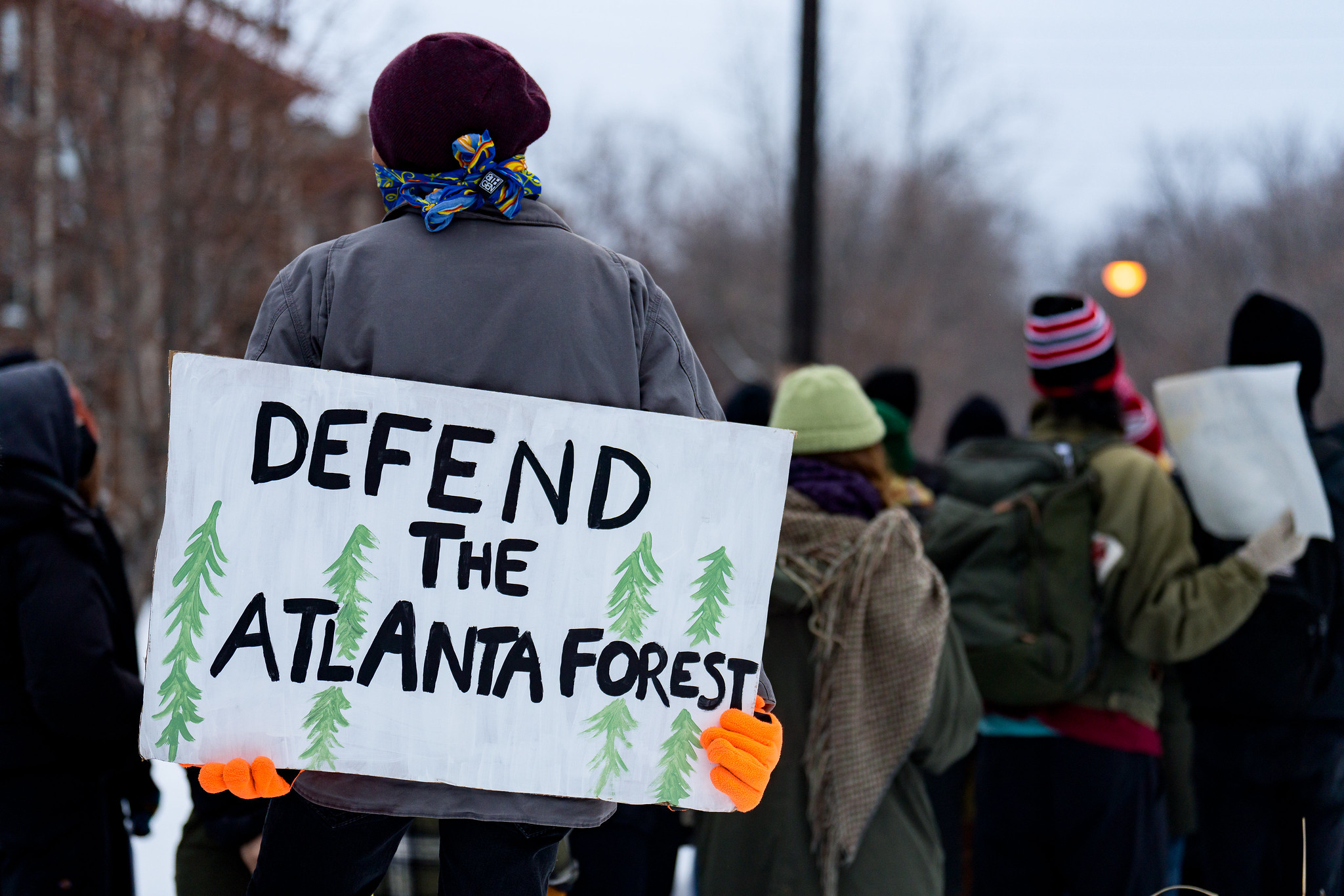
Drawing on my autoethnographic research as a criminalised forest defender, I use participant observation, field notes, and document analysis to highlight two examples of “abolitionist life-worlds” (Chavez-Norgaard et al. 2022) forged by the Stop Cop City movement’s building and fighting strategy: the 2021–2023 Weelaunee forest encampment, and the solidarity communities created by criminalised forest defenders incarcerated in various Georgia jails. Both places represent abolition geographies which relied on an interdependence of building and fighting. In the forest, “radical place-making” (Chavez-Norgaard et al. 2022; Heynen and Ybarra 2021) took shape in destructive direct actions against Cop City’s construction alongside an encampment, which proliferated a wide array of mutual aid infrastructures, networks, and practices—including sharing food, water, shelter, gardens, festivals, and more. These practices worked in tandem with Stop Work orders brought by challengers within the South River Watershed Alliance. In this way, a mixture of insurrectionary, autonomous, and procedural abolitionist tactics worked together to defend the Weelaunee forest as a space where human and non-human life was nurtured and protected (Chua 2024; James 2005; Lang 2022).
A mixture of these approaches were also present in forest defenders’ fight for life within the jails in which we have been incarcerated. Some radical place-making practices while incarcerated included continuously demanding jail guards to meet basic needs for food, water, and healthcare; noise demonstrations which included subversive material support to prisoners; various forms of “uncivil obedience” (Bulman-Pozen and Pozen 2015), such as a collective turn-in including cheering, laughter, joy, and asserting rights; and emotional, spiritual, and material support. In these examples, I find a blend between insurrectionary, autonomous, and procedural abolitionist praxes, demonstrating how abolition geographies were made through a range of practices—a fight against carceral institutions which manifested abolition’s characteristic “fleshly and material presence of social life lived differently” (Gilmore 2022:351).
Cop City is a Death-World
Cop City, forest defenders contend, is a “death-world” (Mbembe 2003:40): a place where critical ecosystems will be decimated to better train police to exercise their right to kill; neighbourhoods will be washed away by increased flooding; while nearby residents suffer from increased air pollution, water contamination, and over-policing by ever more violent officers. The state has protected Cop City using various necropolitical, repressive practices. These include the police murder of Tortuguita; threatening forest defenders with death by police brutality (Field notes, May 2022); medical neglect in custody (Field notes, March 2023); and the state’s attempt to condemn scores of forest defenders to the social death of incarceration and criminal classification as terrorists and racketeers (Center for Constitutional Rights 2023).
A “building and fighting” strategy, advocated by the Southern Black liberationist group Cooperation Jackson, has been critical to the movement’s successes in fending off this myriad of deathly assaults: a combination of building up the solidaristic social relations, infrastructures, and environmental advocacy battles abolitionists believe will keep communities safe, and fighting the carceral infrastructure of Cop City and the criminal punishment system through various forms of destruction and disruption.
In building and fighting, the forest defence campaign aims to fight death with life: the life of the forest and its ecosystem, the life of the surrounding community, and the life of all who require trees to breathe. Throughout movement writings and activities, the Weelaunee forest is often referred to as more than “just” a forest: it is the air we breathe, the water of the South River watershed, the species that rely on the forest ecosystem, protection from climate disaster, a remaining green space among very few, a meeting space for survival networks to offer and exchange resources, and a place to plant fruit and nut trees for future generations to enjoy. The forest is a place where life flourishes: an abolition geography where halting ecocidal police expansion and building mutual aid infrastructures alongside a solidaristic culture of care makes up the everyday practices of abolitionist world-making (Chavez-Norgaard et al. 2022; Hamlin 2023; Heynen and Ybarra 2021; Miyake 2021). A critical part of forging this abolition geography of autonomous collective care included the sabotage of a death-making police militarisation project, primarily using insurrectionary abolitionist tactics of attack and sabotage (Chua 2024; James 2005; Lang 2022) to render the Cop City project itself inoperable, alongside litigation and advocacy by local environmental coalitions.
The RICO indictment of forest defenders alleges that a broad swath of people from around the country—61 defendants now known as the Atlanta 61—are involved in a “criminal conspiracy” to stop Cop City. The indictment describes arrest events as “overt acts in furtherance of the conspiracy”, describing acts which are quite common tactics of protest, such as mutual aid, bail fund organising, handing out flyers, attending a music festival, trespassing, vandalism, or arson. This alleged conspiracy is claimed by the RICO indictment to have begun on 25 May 2020, the day George Floyd was murdered by Minneapolis police officers, sparking nationwide uprisings demanding police abolition. This fabricated “conspiracy” targets the widespread popularisation of the use of a diversity of abolitionist protest tactics during the 2020 protests, and their extension in the Stop Cop City movement. Despite this repression, forest defenders have continued engaging in solidaristic practices supporting the survival of those of us targeted by carceral death-worlds. In particular, criminalised forest defenders and our fellow inmates have utilised both vigorous protest and community care to disrupt jail operations while incarcerated and keep one another alive.
In this article, I draw on autoethnographic field notes and movement documents to show how forest defenders created abolitionist life-worlds within the forest and in jails. I wrote and audio-recorded field notes during and after two brief trips to Atlanta, and in diary entries I have recorded daily after my RICO indictment in August 2023. Some written field notes have been safekept by trusted friends; I have stored audio-recorded field notes in encrypted “Notes to Self” in the Signal messenger app on a burner phone; and I have refused recording many field notes in countless moments of intense paranoia, staunch solidarity, and commitment to protecting myself and others from further repression. These moments guided my choice to focus my methods primarily on autoethnography in dialogue with anonymous and publicly available documentation, to avoid collecting information about others and myself that could (feasibly) be used against us.
Fieldwork while criminalised highlights important access issues (Durban 2022) —due to the dangers inherent to being targeted by the state, “the field” as it is traditionally conceived in ethnographic research required creative reconceptualisation in my case. “The field” took on many different forms and scales, particularly focused within the self and the body (per my autoethnographic approach). My time in “the field” included a stay in the forest encampment and protest participation during the May 2022 week of action; involvement with remote jail and court support from Spring 2023 on; my appearance at my and 60 others’ arraignment hearing; 30 hours incarcerated in Cobb County jail; 30 hours incarcerated in Fulton County jail; regular personal communication and friendship with forest defenders within and around the encampment and anti-repression organisers for nearly three years; and extensive legal, political, and media strategising for collective defence over the past year and a half since my RICO indictment. Much of my research drew on the movement’s social history collected from online archives, including pamphlets, communiques, writings, and films. I analysed these documents by reading them, re-reading them, and coding them for themes that surfaced repeatedly throughout my participant observation and field notes. Within the coded themes, I found resonances with the “building and fighting” strategy I experienced and witnessed.
Carceral State Necropower and Abolitionist Life-Worlds
Michel Foucault’s 1978–79 lectures on “The Birth of Biopolitics” elaborate on a form of modern state power called “biopower”—the power of the modern liberal democratic state to govern and administer the biological life of populations, and to control and create populations by keeping them alive (Foucault 2008). Yet Achille Mbembe (2003) has added to this argument by positing that the inherent deadly violence of the state contributes significantly to the governance of life. The modern state not only holds the power to “make live”—it also holds the power to “let die”, determining the population’s life through the state’s power to end it: “necropower” is just as characteristic of the modern state as Foucault’s “biopower”. Such “death-making” (Mariame Kaba, quoted in Taylor 2021) by the state can be instant and physical, in the form of executions or police terror; death can be social, in the form of incarceration; death can be slow, in the form of a lack of healthcare or other basic needs. The modern state’s characteristic legitimate monopoly on violence within the bounds of a territory (Weber 1965) means that the state’s ability to wage deadly violence to retain its power is constantly legitimised by the state and many members of the population. The legitimate deadly violence of the state is institutionalised and carried out by police and the system of policing—the police exist to perform the “violence work” of the legitimated, violence-monopolising state (Seigel 2018).
Mbembe (2003) emphasises that this death-making power relation between states and state subjects is racialised, demonstrated by racial capitalist state formations such as the carceral state, the colony, and the imperial military. Grounded largely in the US context, much abolitionist scholarship and praxis has focused on the need for social transformation out of a nation-state built on slavery and its racial capitalist legacies. Abolitionists seek to dismantle the remains of the plantation as a racialised system of social control, in its current form as a “time-space that tracks the plantation toward the prison and the impoverished and destroyed city sectors and ... an ongoing locus of antiblack violence and death” (McKittrick 2013:2–3). Much abolitionist theorising of this dismantling is rooted in W.E.B. Du Bois’s (1935) concept of “abolition democracy”, which specifies abolitionist aspirations as more-than-destruction of deadly racist institutions such as slavery, the carceral state, and their legacies of racial inequality. Abolition democracy envisions a US government free from racism and racial capitalism (Du Bois 1935; Lester 2021).
Some abolitionists have taken the abolition democracy vision further than the US government, advocating for its manifestation in alternatives to the US state as whole (i.e. Hamlin 2023; Revolutionary Abolitionist Movement 2017), or the carceral state in particular (i.e. Kaba 2021). Angela Davis (2005:92) summarises this position as advocacy for “an array of social institutions that would begin to solve the social problems that set people on the track to prison, thereby helping to render the prison obsolete”.
The goal of manifesting a new vision for society beyond the carceral state takes many forms, most prominently including transformative and restorative justice approaches to seeking community accountability for harm (Kaba 2021; Sered 2021), and autonomous “life-affirming institutions” (Gilmore 2017), which demonstrate community capacities for solidaristic care, safety provision, and creating “new life-worlds” (Chavez-Norgaard et al. 2022; Chua 2020, 2024). These forms of abolition present alternatives to the carceral state that effectively accomplish the task of procuring community safety. In his discussion of the abolitionist potential of the 2020 George Floyd uprisings, Justin A. Lang (2022) draws on the writing of Joy James (2005) in describing these infrastructures as “autonomous abolition”, a series of tactics and strategies which focus on “building hyperlocal infrastructures as alternatives to the carceral state to sustain communities and resistance” such as “mutual aid formations, survival programs, people’s assemblies, [and] anti-repression formations” (Lang 2022:n.p.).
Less formally, abolition has also been conceptualised as “an everyday practice” (Heynen and Ybarra 2021:26) of keeping one another safe and supported. This practice is particularly important to forging abolition geographies, which can be broadly understood as the spatial and place-based invocation of abolitionist praxis (Gilmore 2022)—it is an iterative process of envisioning and manifesting what abolition would mean in the social world, variously referred to by abolition geographers as “radical place-making” (Chavez-Norgaard et al. 2022; Heynen and Ybarra 2021), “freedom as a place” (Gilmore 2007:227), and “a fleshly and material presence of social life lived differently” (Gilmore 2022:351). Keith Miyake (2021:595) offers a range of examples of how abolitionists “[make] abolition geographies”, transforming places by:
inscribing freedom into landscapes through the proliferation of new structures and infrastructures; social relations and cultural practices; dreams and experiments; ontologies and practices, rooted in collective ways of being. Abolition is not a metaphor, but rather, a framework and concrete process of freedom making through the dialectic negation of unfreedom.
Overall, scholars have theorised that abolition and its geographies consist of the continual practice, process, and imagination of a world which supports and organises the conditions for life to thrive. Abolitionists wield these conditions as tactical and strategic means of opposing the death dealt by the necropolitical carceral state.
Abolitionists often emphasise their political praxis as primarily a creative process of “making things” (Gilmore 2022:351). In addition to abolition as a creative praxis, it is also critical to discuss destructive praxes of abolition, wherein carceral infrastructure is destroyed or disrupted in order to clear or create space for abolitionist creativity. Kass and Dunlap’s (2025) and Lang’s (2022) analyses of the 2020 George Floyd uprisings emphasise that their abolitionist potential came from the combination of autonomous abolition with “insurrectionary abolition”, a destructive form of abolition which involves “direct action and confrontation with the state”, using tactics such as “rioting, looting, attacking state structures, taking territory, eviction defense” (Lang 2022:n.p.). Without destructive tactics of insurrectionary abolition in the 2020 uprisings, the creative tactics of autonomous abolition might not have had the resources or geographies to flourish in the first place.
The combination of insurrectionary and autonomous abolitions can also offer an alternative or complement to popular forms of “procedural abolition” which rely on “achieving abolition through non-reformist reforms to reshape state infrastructure” (Lang 2022:n.p.), and their limitations given the state’s investment in policing and its monopolised legitimate use of violence (Chua 2024). When abolitionists strategically combine procedural approaches with insurrectionary and autonomous approaches, the fight for abolition can be made significantly stronger.1 Indeed, a diversity of forest defence efforts have contributed to the stoppage of the Cop City development over the course of years of struggle. Forest defenders from all of these factions (and beyond) have refused to denounce one another’s tactics, supported one another through repression unconditionally, and have resisted co-optation—becoming stronger together. This article demonstrates the importance of this combined insurrectionary-autonomous-procedural approach to building and fighting for the abolition geographies forged by the Stop Cop City movement.
Fighting Death with Life in the Forest
Both ecological and social life-affirming infrastructure sustained the efforts of various factions of forest defenders. Local coalitions of ecologists and environmental advocacy efforts fought alongside forest defence efforts within the encampment with the invocation of Stop Work orders. Agroforestry efforts within the forest served both social and ecological functions by expanding the forest ecosystem as an antidote to deforestation, and as a tree-canopy shield for the forest occupation, while also establishing forest gardens intended to sustain communities in future generations. In tandem, the space of the forest was held by those who fought against cops and developers, as well as those who engaged in direct actions against machinery which threatened to destroy the forest and dismantle the encampment.
The forest became a site of resistance against carceral expansion in its multiplicity of abolitionist tactics. These included a procedural approach to abolition using litigation and call-in campaigns to fight for both human and non-human life undermined by Cop City’s water pollution, and autonomous and insurrectionary approaches, such as forest gardening for food, ecological restoration, and illegibility; building mutual aid infrastructures within the forest encampment; and defending the encampment by fighting agents of forest destruction.
All of these efforts signify forms of “abolitionist life-worlds” (Chavez-Norgaard et al. 2022) forged in the process of “radical place-making” (Heynen and Ybarra 2021) which defines abolition geographies (Miyake 2021) in their varying approaches to “building and fighting”. They simultaneously build relations and infrastructures which aim to affirm, sustain, and protect life, while fighting against Cop City’s damage to the life and well-being of human and non-human residents of the forest and its surrounding neighbourhoods.
Trees Give Life
Various social and ecological infrastructures, relationships, and efforts kept up life within the encampment throughout its nearly two-year lifespan. Forest defenders in a makeshift kitchen with water tanks for dishwashing cooked meals en masse, served on long card tables in the “Living Room”—a clearing and community space where meetings and meals took place. A free store offered medicine, bug spray, sunscreen, and toiletries. Local food recovery and distribution networks delivered food to sustain the encampment. A “sacred fire”, always lit, illuminated paths and kept passersby warm. Free meals, free stuff, religious services, guerilla gardening, and fun parties frequently drew people of all kinds into the trees (Field notes, May 2022; Rose Warfare 2022).
In March 2023, forest gardeners “plant[ed] hundreds of fig, pawpaw, and persimmon saplings, distribute[d] fruit trees to neighbors, learn[ed] the arts of grafting and herbal medicine, and restore[d] an area of forest that had been disturbed by illegal demolition work” (Lary and Tycko 2023:n.p.). In this way, trees gave life to the surrounding ecosystem through restoration and feeding future generations. Grafting fruit and nut trees also acts as a mutualistic, life-giving relationship between the tree and the grafter; grafting allows trees to grow stronger, preserve resources, remain resilient to drought and pathogens, and ultimately, provide more food. In response to clear-cuts made “at the request of the GBI2 and Dekalb [sic] SWAT3 to inhibit the ability of ‘anarchists’ to traverse the forest under the cover of its canopy ... dozens of participants planted willow and long leaf pine trees throughout these clearings” (ACPC 2023), holding soil life and composition together while protecting the forest encampment from state legibility by maintaining the opacity offered by the forest’s tree canopy (Scott 1998).
In addition to these restoration efforts, the South River Watershed Alliance and their allies have used litigation to halt Cop City’s construction, challenging developers’ compliance with land disturbance permits, successfully achieving several Stop Work orders which at times coincided with heightened participation during weeks of action.
After Tortuguita was murdered, their mother came to the forest from her home in Panama to spread their ashes amongst the orange-pink fallen pine needles. Next to the ashes, forest defenders planted fruit and nut trees, to help sustain future generations and commemorate Tortuguita’s life (Personal communication with forest defender, March 2023; ACPC 2023). In the days after Tortuguita’s murder, protesters in the streets exclaimed their abolitionist life-worlding position in a nutshell, emblazoned on a banner at the front of the crowd: “Trees give life. Police take it” (Anonymous 2023b).4
All of these efforts to restore, protect, and replenish human and non-human life in the face of deadly carceral expansion were complemented by insurrectionary abolition as direct action in defence of the forest. Alongside the forest encampment and the building of life-affirming infrastructure within it, forest defenders took direct action in order to materially prevent the project’s construction. Bulldozers were burned to the ground from the very beginning of the movement. On 17 May 2021, shortly after local activists and ecologists had discovered the Cop City plan, a communique was released claiming responsibility for the destruction of seven machines: “chiefly tractors and excavators ... are vandalized. Their windows are broken, their tires cut, and they are set on fire” (Anonymous 2022a:n.p.). The communique stated: “We don’t need police training facilities. We demand an end to policing ... Any further attempts at destroying the Atlanta Forest will be met with similar response. This forest was here long before us, and it will be here long after” (Abolition Media Worldwide 2021, quoted in Anonymous 2022a:n.p.). This sabotage sparked a string of other attacks, including more excavators being burned in June 2021, and the installation of tree spikes to damage saws used to cut down trees. These destructive actions paved the way for the encampment’s initial establishment in November 2021. Forest defenders built and occupied treehouses as part of the encampment that fall and winter.
Just as destruction cleared the way for the encampment’s construction, fighting was a critical companion to the encampment’s ability to continue building abolitionist alternatives in the forest. Taking care of one another sustained the encampment and characterised its culture, and fighting against threats to it was what made it possible.
May 2022 Week of Action: “A Cop-Free Zone”
Both a combative orientation against agents of forest destruction and a caring orientation toward agents of forest defence were equally crucial, co-existent aspects of defending Weelaunee. As one movement history pamphlet put it, “Many of the participants ... arrived prepared to take direct action against the Police Foundation and its affiliates, aiming to shift the balance of power” (Anonymous 2023b:n.p.). The atmosphere of the encampment in May 2022 was joyful and solidaristic in both its proliferation of community care infrastructure and relations and in sudden moments of heart-stopping fear, when news of forest destroyers encroaching alerted forest defenders with a call to action. Shifts between these states of being were part of encampment life during my stay there (Field notes, May 2022). As one communique puts it, “The slow time of the forest breaks through the fast time of crisis, and two different worlds slide past each other. In one, my fast-beating heart. In the other, the calm and patient vastness of a centuries-old water oak” (Autonomous Farming Collectives 2022:n.p.).
As more and more people came to the forest to grow the encampment and movement as a whole, forest defenders chased police officers and construction workers out of the forest with thrown rocks, Molotov cocktails, and fireworks, in conjunction with subversive advocacy, or “uncivil obedience”—a method of protest which involves engaging in legal activity or obligations in subversive ways (Bulman-Pozen and Pozen 2015). The May 2022 week of action exemplified this dynamic; as more than 200 people camped in the forest to defend it from clear-cutting, “forest defenders awoke to the sound of falling trees” (Anonymous 2023b:n.p.) on 9 May, the first day of the week of action. They quickly learned that construction crews had begun to fell trees, so:
[a] number of determined people responded immediately, repelling the bulldozers with a few stones before linking arms and chanting “move back” in unison at police officers further afield ... Later, DeKalb County issued a “Stop Work” order, ostensibly following a flurry of calls by lawyers and neighborhood groups ... In the following days, amid assemblies, workshops, shared meals, mushroom walks, and informal socializing, those gathered for the week of action endeavored to make the Weelaunee Forest into a cop-free zone. Whenever officers approached the area, venturing into the parking lot or parking their vehicles nearby, activists confronted them. In some instances, several dozen people descended from multiple sides of the forest, rushing police vehicles, slashing tires, smashing windows, throwing rocks. (Anonymous 2023b:n.p.)
In the case of the May 2022 week of action, the three abolitionist approaches combined and reinforced one another powerfully. Procedural abolitionists and their allies forced the Stop Work order via their call-in campaign, which helped protect the encampment from the threat of clear-cutting by construction workers. At the same time, the encampment enjoyed protection from the insurrectionary abolitionists, who took destructive and combative direct actions on behalf of the forest defence campaign by clearing the forest of cops and bulldozers. As these factions worked together to clear the space of forest destroyers, the forest became a place for autonomous abolition to flourish. Together, these forms of abolition prefigured a life-world which sustained the trees and their defenders.
July 2022 Week of Action: Property vs. the Commons
The week of action in May 2022 was a prominent instance of the movement’s building and fighting for abolition within the Weelaunee forest using procedural, autonomous, and insurrectionary abolitionist praxes. That same strategy continued into the July 2022 week of action.
Musical groups initiated this week of action, declaring there would be a music festival in the forest to support the movement. Artists from different musical genres took part, “including performers from the regional dance, indie, folk, hip hop, and hardcore punk music scenes” (Anonymous 2023b:n.p.). Ahead of the July week of action, the South River Watershed Alliance had successfully pushed for a Stop Work order on the Intrenchment Creek Park side of the forest.
Despite this, on 19 July 2022, DeKalb County sheriffs had placed concrete barriers at the park’s trailhead, along with “No Trespassing” signs. As the music festival and week of action continued, “a group calling themselves ‘100 Cute Little Ants’ moved the heavy barriers to the side, opening enough space for one or two cars to enter at a time. The new placement of the barriers allowed civilians to enter with ease, but made it difficult to operate large machinery or vehicles in the small entranceway”, writes one account (Anonymous 2023b:n.p.). Anonymous forest defenders covered the barriers in graffiti, redecorating their grey concrete with community.
Another account from the July week of action reflects on how, in that moment, forest defenders directly resisted property enclosure in favour of their vision of the forest as a commons:
What—another space in the city enclosed, forbidden, made concrete? Long before this struggle began—a struggle for my neighborhood park, my local forest—I could trace my life through a string of interactions with police in public parks, or a string of neighborhood parks and natural spaces closed, contaminated, forbidden ... if you want to be outside, you have to pay or you have to trespass ... People make the spaces they need. I smiled when I saw them opened up ... A disregard for property lines ... Hundreds of people stream into the forest to enjoy a free concert, a barbecue, the company of others in the movement ... a crowd gathers around the front of the barriers. I notice that people are hoisting a new sign, painted with a new name. They welcome me in through the barriers. I help hold the sign, heavy in my hands, as it is affixed to the old sign stand ... A few moments later, a DeKalb County police SUV slow-rolls by, but a crowd has already started to amass at the barrier entrance. Some shouts of mocking harassment from a crew of masked people send the cop down the road. “He won’t be back.” (Anonymous 2022b:n.p.)
This account, and several others, emphasises the power of taking land back directly from police for commons prefiguration in the property battle which took place between forest defenders and forest destroyers during the July 2022 week of action. Forest defenders moved the concrete barriers to reopen the park as a park, marked by a joyous ribbon-cutting ceremony and unveiling of a sign which read “Weelaunee People’s Park”, upheld at the newly configured entrance (Anonymous 2022b; Anonymous 2023b).
On the last day of the July 2022 week of action, forest defenders awoke to a call to action: a tow truck belonging to a developer had made it into the parking lot, attempting to remove park goers’ cars. In response, a crowd of forest defenders emerged from the trees, destroying the emergent tow truck by smashing its windows, throwing stones and seltzer cans; later, an account affirms that the tow truck “was in pieces. The catalytic converter was removed, the interior was stripped, the engine was destroyed ... Eventually, after everyone had dispersed from the parking lot, someone set the truck on fire” (Anonymous 2023b: n.p.). After the smoke cleared, “the truck became an attraction” (Anonymous 2022b:n.p.) where people took selfies and pictures (Anonymous 2023b; Rose Warfare 2022). In the days after, the remains of the truck became a garden; forest defenders began filling its trunk with soil and wildflower plants (Personal communication with forest defenders, July 2022).
In a variety of instances, the Weelaunee forest became an abolitionist life-world which forest defenders both built and fought for. In the case of the July 2022 week of action, creating an abolition geography took on the form of “desanctifying property” (Dawson 2022)—forest defenders endeavoured to create an abolitionist space without the presence of cops or the “protection” of the forest-as-property on behalf of Cop City’s police expansion. This was achieved through both autonomous and insurrectionary abolitionist tactics, involving forest defenders’ co-constitution of attacks against agents of forest destruction and their property, including developers, construction workers, and police alongside the building of infrastructure, solidarity, and joy, which both prefigured and sustained an alternative vision for the forest.
“We’re all comrades”: Life-Worlds against the Death-Worlds of Georgia’s Jails
The state’s repression of this movement has never stopped forest defenders from continuing to build abolitionist life-worlds beyond the carceral state. Even after the forest occupation ended in 2023, these potentialities transcended the physical space of the forest. In various instances in which forest defenders have been incarcerated, the life-worlds teeming from the forest remained with us even in the face of incarceration’s world of death in our acts and relations of resistance, refusal, care, solidarity, and mutual aid.
Among the RICO defendants, the abolitionist life-world of the forest was carried with us in our spirit of solidarity, love, joy, and resistance against the state’s attempts to suppress and kill us through incarceration. We took care of each other in the cages of the deadly Fulton County jail, refusing to leave anyone to die. On 6 November 2023, the Atlanta 61 were arraigned in the Fulton County Superior Court, where the judge ordered us to turn ourselves in to the Fulton County jail within 24 hours of the hearing. Outside the jail before nine the next morning, we hugged our loved ones tightly, drawing in our breath in preparation for the worst. Fulton County jail is notoriously one of the most dangerous and lethal jails in the US; ten people died while in custody there between January and September 2023, and 15 inmates died while in custody there in 2022. Among the deceased was 35-year-old inmate Lashawn Thompson, who was found dead in his cell after being eaten alive by insects (Weill-Greenberg 2023). Detainees regularly suffer from malnourishment, as well as lice and scabies infestations (Weill-Greenberg 2022). Fulton County jail is a quintessential death-world: it is where criminalised people are sent to languish and die, despite the jail’s population overwhelmingly containing inmates who are incarcerated pretrial and thus legally presumed innocent.
The other jails in which forest defenders have been held have similarly abhorrent records of lethality. In DeKalb County jail, nine inmates died of hypothermia, suicide, and medical neglect in 2022 alone (Whisenhunt 2023). In Stewart Detention Center, the Immigration and Customs Enforcement (ICE) facility where one forest defender was held, nine people have died since 2017 (Southern Poverty Law Center 2023). These jails are the epitome of Mbembe’s (2003:40) “death-worlds”—in these places, the state’s use of violence to maintain power and enforce its laws is defined by tortuous, deadly conditions.
Uncivil Obedience as Abolitionist Praxis
Even as the Atlanta 61 obeyed the state’s orders for us to turn ourselves in, we did so in ways that still allowed us to resist our predicament. This “uncivil obedience” (Bulman-Pozen and Pozen 2015), particularly as the Atlanta 61 practised it, can be understood as a form of abolitionist praxis which defies categorisation as “insurrectionary”, “autonomous”, or “procedural”—it is disruptive and caring; it is at once occurring within, yet against, the state. Uncivil obedience is a form of law-following which technically stays within the bounds of the state’s rules, yet in unruly ways. Even as we went through the turn-in process, we did so collectively —we took care of each other, and kept each other safe.
As our co-defendants were booked into the jail one by one, we watched through the tiny windows of our holding cells; we clapped and cheered on each co-defendant as they stood before a grey background, and found themselves smiling from the support as a camera snapped their mugshots. Later, we were taken to a holding cell in the back of the jail where 21 of us were held together. We played group games to pass the time and keep our spirits up, ranging from guessing games to theatre games, laughing and whooping and smiling in the most unlikely of dungeons. The concrete and metal benches of the cells compressed and tightened our muscles, so we taught each other gymnastics, calisthenics, dance and yoga moves to shake the stiffness off together.
As night fell, we tried to survive the freezing temperature and bright lights enough to fall asleep. We were given floor mats to sleep on, but no bed sheets, blankets, or pillows. Checking in with each other, we gauged one another’s comfort with cuddling: “Down to spoon? I’m freezing.” Sliding black Covid masks over our eyes to block out the overhead lights, we nestled into the warmth of one another’s body heat, forming a spooning train across the floor of the cell. Only once I was encased completely in others’ body heat was I able to grasp a brief moment of sleep (Field notes, November 2023).
Care and Solidarity as Survival in Georgia’s Jails
Many other stories from incarcerated forest defenders indicate how solidaristic social relations, which tended to take on both confrontational and caring shapes, begin the process of abolition through radical place-making. In an article published by the movement-aligned media collective Unicorn Riot, Priscilla Grim, who was charged with domestic terrorism and RICO for her mere alleged presence at a music festival in the forest, describes several examples of mutual aid among inmates in her podcage in DeKalb County jail. Forest defenders and other inmates took turns teaching seminars for one another. “Topics included Spanish, cryptocurrency, basic emergency first responder skills, financial literacy, and pressure points for massage therapy” (Fatica 2023:n.p.).
Forest defenders and their fellow inmates cultivated a culture of caring for one another in this particular podcage, where “[w]e’re all comrades” (Grim, quoted in Fatica 2023:n.p.). One of the ways they did this was by communicating with those who were stealing commissary items from one another, letting them know that it was unnecessary when freely sharing resources and caring for each other could be prioritised. Over on the AMAB5 side of the jail, fellow musical festival arrestee Jamie Marsicano turned 30 years old. Feeling down and depressed that her fourth decade was beginning in jail, Jamie was uplifted by a group effort to make an elaborate birthday cake for her out of squished together honey-buns, Oreos, and pink Kool-Aid dye from the commissary (ACPC 2024).
Care as survival in jail was also evident in the presence of jail “moms”, women resembling mother figures in their extension of care to fellow inmates, often younger women or AFAB6 folks. In another account written by Priscilla Grim, she describes a woman she calls “Dulce”, who:
had become the podcage’s mom and mutual-aid hub. People gave her the items they didn’t need to take with them when they left jail. When I was arrested, my glasses were in my bag. I didn’t know I would be held for so long, so I didn’t ask for them ... If it had not been for Dulce, who gave me a pair of glasses a former resident of the podcage had left or forgotten, I would not have been able to read or see any details during my time incarcerated ... Dulce also said, “If the podcage energy seems off, lock yourself in your cell.” Her guidance saved me from violent encounters with people unable to regulate their emotions. (Grim 2024:n.p.)
In Cobb County jail, my jail mom was a woman we called Miss Kandy.7 After many hours of being booked into the freezing cold jail wearing only clothes suitable for a summer day in Georgia, we inmates on the AFAB side of the booking room had tried to huddle together for warmth. Each time we tried to huddle, we would be put on lockdown in solitary confinement to a holding cell with encrusted vomit on the walls. About 25 hours in, Miss Kandy appeared in the booking room, draped in sweaters; she looked vaguely like an apparition, or an angel with wispy wings. She had come from gen pop8 to give us sweaters knowing that it would be cold, and that many of us would not be dressed for the temperature or offered any extra clothing.
From there, she stayed with a gaggle of us as we began receiving our charges and bond amounts, and our collective rollercoaster of emotions and thought-spiralling that came with them, a spinning cyclone: Wow, $22,000? $45,000? Felonies?? I’ve got priors, I’m fucked. I wasn’t even doing anything. What the fuck. Will we ever get out of here? Am I gonna go to prison? Will I get fired? I don’t have anywhere to go. I can’t pay this. My kids, I’ve let my kids down over and over again... Despite not being one for Jesus talk, Miss Kandy’s spiritual counsel was a soothing balm for me over the course of the next many hours she sat with us in our crowded holding cell. For each one of us, she listened intently to our individual worries, and responded with the knowing of our predicaments playing a unique role in our purpose, our divine path—that it was all happening the way it was meant to, and to be brave. She held us and spoke about God and Jesus to us softly as we cried and fell asleep, exhausted from being held in brightly lit, freezing conditions with only metal benches in the holding cells to sleep on (Field notes, May 2022).
After my release and upon my eventual RICO indictment, I would think of Miss Kandy often. I would feel the regretful, embarrassed sting of my naivety and fear in that filthy holding cell; then awash in the glow of pride in retrospect, of the bravery built since—her stern certainty that I would grow stronger from this, coming to fruition.
Disruptive Protest and Community Care
Confrontations with jail guards and bureaucracies were, in and of themselves, important forms of community care for incarcerated forest defenders. At times, building a culture of community care required fighting for basic building materials—fighting can itself be part of the building process.
Victor Puertas was arrested at the same music festival in the forest as Priscilla Grim and Jamie Marsicano, and was also charged with domestic terrorism and RICO. Victor was transferred to an ICE detention centre in Lumpkin, Georgia, where he remained incarcerated for nearly a year. While there in late August 2023, he organised with hundreds of his fellow inmates to launch a hunger strike in protest of the abhorrent conditions of the facility’s meals, which were often served in too-small portions, mouldy, rotten, and lacking in nutrition. “We’re asking right now for the full menu to improve”, Victor told Sean Summers (2023) of Unicorn Riot in an interview via phone from the facility: “We’re asking for fresh produce, more fruits and vegetables ... for real meat, more milk and eggs. What’s necessary to feed ourselves, and to be healthy ... to be treated with respect and dignity”. In other instances of incarceration and neglect, call-in campaigns to the jail among activists on the outside were common, and often led to medical, hygiene, and other needs being met (Field notes, March 2023 and November 2023; Grim 2023). Directly outside the jails, vigils and noise demonstrations have been held, embodying both a confrontational and caring character. While inside Cobb County jail, the faint sounds of protestors yelling for our freedom, banging pots and pans, and playing loud instruments caught in my throat, moving me to tears. I had never experienced the feeling of being held, loved, and supported quite that viscerally before, despite its competition with the visceral sensations of the jail’s stench, freezing temperature, and sleep deprivation.
These demonstrations regularly occurred after arrests within the movement (Anonymous 2022c; Anonymous 2023c). After the November 2023 “Block Cop City” action, where hundreds of forest defenders were confronted by riot police in their attempt to re-occupy the forest, the noise demonstration outside DeKalb County jail offered material support to prisoners:
a line started dropping from one of the windows, with a bag tied to the bottom. Instantly the crowd knew what was necessary and assembled cigarettes, pizza, and water bottles for the folks inside ... a heroic attendee darted from the crowd and filled the bag with the goodies, before disappearing back into the center of the safety of the crowd, being shielded by those around them. The bag was raised and brought into the cell. Then another bag dropped, and this time a group of six people made the run for it together and loaded it up, before similarly returning to the protection of the crowd. (Anonymous 2023c:n.p.)
Disruptive protest played an important role in getting the Atlanta 61’s collective needs for survival met in Fulton County jail. When the lunch hour came around, the guards handed out sandwich packs—circles of baloney melted into cheese between slices of white bread contained in plastic bags, mustard packets buried deep between ingredients. After scarfing down our sandwiches—the first meal of the day—we realised that we may not eat again for a long time, and we were unsure of when the next time might be. The non-potable sink water refused to dribble from the faucet; there was no toilet paper or soap in the bathroom corner of the cells. This began a campaign that continued for the remainder of our incarceration, where we periodically worked together to bang on the holding cell doors and scream at the guards, demanding water, food, and toilet paper. With much exasperation toward our disruption, the guards relented, and we created a communal stockpile of survival supplies containing sandwich packs, toilet paper, and water cups (Field notes, November 2023).
As the Atlanta 61 underwent booking into Fulton County jail, personal and medical information was collected by jail authorities at every turn. Uncivil obedience played a role in how we dealt with this invasion; particularly, the use of rights to privacy as a protective mechanism to keep one another safe. Inmates began to advise one another of their rights to refuse the collection of bodily fluids and information, such as urine samples and questions about mental health history. Even if the information seemed innocuous, we understood that any possession of personal and medical information about us by the state could be twisted and used against us. As more of us acquired this understanding, we made sure all of us knew our rights to privacy and protection from possible incrimination. As we were processed through the medical wing, the jail nurses appeared perplexed as we moved swiftly in a line through their invasive medical questions, repeatedly responding “I decline to answer”.
During our 30 hours inside Fulton County jail, the Atlanta 61 had kept one another alive, despite the state’s efforts to crush the life of the movement. In many other instances where forest defenders have been incarcerated, we have been kept alive and helped keep others alive. As anarchist geographer Simon Springer (2016:11–12) notes, “[w]e are able to reclaim the commons ... through our connections to each other ... you cannot separate a claim to the commons from the relational connections that exist between individuals acting in the interest of mutual aid”. The movement’s reclamation of the commons is entwined with direct resistance against the forces which seek to enclose them.
Conclusion
The Stop Cop City movement demonstrates the equal and interdependent importance of destruction and disruption in the process of creating new abolitionist life-worlds. The movement has drawn inspiration from the 2020 George Floyd uprisings, particularly given links between the development of Cop City as a remedy for the post-2020 demoralisation of Atlanta police departments (Herskind 2023). Defending the forest has meant heeding the lessons of nationwide abolitionist uprisings, and halting the dispossession of people from both land and abolitionist possibilities for genuine community safety. This heeding and halting emerges from a collective reclamation and prefiguration of this different way of life.
On the ground in the Weelaunee forest, the 2020 moment, its means, and its meanings have explicitly linked the struggle for land with the struggle for police abolition; both the “autonomous abolition” of building life-worlds, and the “insurrectionary abolition” of destroying death-worlds: then police precincts, now Cop City (Chua 2024; James 2005; Kass and Dunlap 2025; Lang 2022). The strategic and tactical continuation of the 2020 struggle against the police has lived on in the same building and fighting for the right to live that proliferated in the streets in cities across the country.
It remains critical for us abolitionist scholars and practitioners to learn from the building and fighting strategy of the Stop Cop City movement, and take those lessons with us into current and future abolitionist struggles. This strategy and how it has unfolded in movements like Stop Cop City must compel us to wield every tactic of prefiguration possible in the struggle for abolition—to think and act both creatively and destructively, and to leverage the tools available to us in dismantling the carceral state, wherever we might find ourselves.
Without the clearing of death-making forces from the forest, life within it would not have remained or flourished. And without working together to fight to keep one another fed, warm, resilient, and safe from further incrimination, the deadly jails in which forest defenders were incarcerated might have defeated us. After our release from jail, the fight for the life of the forest has continued in the fight for the life of the fighters as the prosecution drags onward. In the meantime, abolitionist praxes—from the procedural, the autonomous, and the insurrectionary— continue to blur together as a strategy of tactical diversity. Participatory defence, ongoing litigation, carceral infrastructure sabotage, and supporting one another has remained central to the continuation of the Stop Cop City struggle in the forest encampment’s afterlife, as lockdowns to construction equipment, direct actions, and care networks for forest defenders and defendants have proliferated against all odds.
Trees continue to give us life—even as police continue to try and take it.
Acknowledgements
This article is dedicated to Tortuguita, the Atlanta 61, and life-defenders everywhere. I am grateful to the Antipode editorial team and anonymous referees for their thoughtful and encouraging feedback on this paper, which vastly improved the final piece. The article benefited from feedback and undying support from my incredible doctoral dissertation committee members: Michael Bell, Morgan Robertson, Matt Turner, Jenna Loyd, and Holly Gibbs. I am forever thankful for the support, solidarity, and guidance from my defense committee, support crew, family, friends, colleagues, the Atlanta Solidarity Fund, Atlanta Jail Support, the Civil Liberties Defense Center, the National Lawyers Guild, and most of all, my brilliantly talented and patient attorney, Amith Gupta.
Data Availability Statement
Research data are not shared.
Endnotes
1. Abolitionists using procedural approaches must be careful to remain genuinely supportive of, rather than counterinsurgent, co-optative, or otherwise distracting/detracting from insurrectionary and autonomous approaches (see Kass and Dunlap 2025).
2. Georgia Bureau of Investigation.
3. Special Weapons and Tactics.
4. See the photograph at https://crimethinc.com/2023/02/22/the-forest-in-the-city-two-years-of-forest-defense-in-atlanta-georgia (last accessed 14 March 2025).
5. Assigned Male At Birth.
6. Assigned Female At Birth.
7. Name has been changed for privacy.
8. General population, where jail inmates are detained after being fully booked into the facility.
References
11Alive (2023) Atlanta police bodycam video from shooting at “Cop City” site. 9 February https://youtu.be/rT-Lqv5n-ak?si=xT4ZK2vnqMmRBRYm (last accessed 24 March 2025)
Abolition Media Worldwide (2021) Attack on deforestation machinery in Atlanta Forest. 18 May http://web.archive.org/web/20210518045336/https://www.amwenglish.com/articles/attack-on-destructive-machinery-in-atlanta-forest/ (last accessed 21 March 2025)
ACPC (Atlanta Community Press Collective) (2023) “We are not in the least afraid of ruins”: Food autonomy in the Weelaunee forest. It’s Going Down 20 March https://itsgoingdown.org/we-are-not-in-the-least-afraid-of-ruins-food-autonomy-in-the-weelaunee-forest/ (last accessed 24 March 2025)
ACPC (Atlanta Community Press Collective) (2024) “The ATL 61: In Their Words—Episode 2.” https://www.youtube.com/playlist?list=PLySCgkjD0seI1hFDXs-tW8HTusHyyIpou (last accessed 24 March 2025)
Anonymous (2022a) The city in the forest: Reinventing resistance for an age of climate crisis and police militarization. CrimethInc 11 April https://crimethinc.com/2022/04/11/the-city-in-the-forest-reinventing-resistance-for-an-age-of-ecological-collapse-and-police-militarization (last accessed 21 March 2025)
Anonymous (2022b) Beneath the concrete, the forest: Accounts from the defense of the Atlanta forest. CrimethInc 9 August https://crimethinc.com/2022/08/09/beneath-the-concrete-the-forest-accounts-from-the-defense-of-the-atlanta-forest (last accessed 21 March 2025)
Anonymous (2022c) Noise demo in Atlanta follows violent arrests of forest defenders. It’s Going Down 15 December https://itsgoingdown.org/noise-demo-atlanta-forest-2022/(last accessed 21 March 2025)
Anonymous (2023a) Atlanta police and Georgia State Patrol are guilty of murder: The evidence and the motive. CrimethInc 20 April https://crimethinc.com/2023/04/20/atlanta-police-and-georgia-state-patrol-are-guilty-of-murder-the-evidence-and-the-motive (last accessed 21 March 2025)
Anonymous (2023b) The forest in the city: Two years of forest defense in Atlanta, Georgia. CrimethInc 22 February https://crimethinc.com/2023/02/22/the-forest-in-the-city-two-years-of-forest-defense-in-atlanta-georgia (last accessed 21 March 2025)
Anonymous (2023c) Report back on jail vigil outside DeKalb County jail following “Block Cop City” mobilization. It’s Going Down 15 November https://itsgoingdown.org/block-cop-city-jail-vigil-noise-demo/ (last accessed 21 March 2025)
Autonomous Farming Collectives (2022) Planting and becoming. e-flux Journal 128 https://www.e-flux.com/journal/128/472900/planting-and-becoming/ (last accessed 21 March 2025)
Berger D (2023) RICO and Stop Cop City: The long war against the Left. The Law and Political Economy Project 11 September https://lpeproject.org/blog/rico-and-stop-cop-city-the-long-war-against-the-left/ (last accessed 24 March 2025)
Bulman-Pozen J and Pozen D E (2015) Uncivil obedience. Columbia Law Review 115 (4):809–872
Center for Constitutional Rights (2023) Supporting the movement to Stop Cop City. 21 August https://ccrjustice.org/supporting-movement-stop-cop-city (last accessed 24 March 2025)
Chavez-Norgaard S, Montagne L, Sayers J E and Ybarra M (2022) Making abolition in geography. Society+Space 31 October https://www.societyandspace.org/forums/making-abolition-in-geography (last accessed 24 March 2025)
Chua C (2020) Abolition is a constant struggle: Five lessons from Minneapolis. Theory and Event 23(4):127–147
Chua C (2024) An “against” and a “for”: Abolitionist reckonings with the state. Contemporary Political Theory 23(1):114–120
Davis A Y (2005) Abolition Democracy: Beyond Empire, Prisons, and Torture. New York: Seven Stories Press
Dawson M K (2022) The Kings ain’t playin’ no one tonight: Desanctifying property as abolitionist practice in Sacramento. Environment and Planning D: Society and Space 40 (2):319–331
Defend the Atlanta Forest (2022) “Media Kit.” https://defendtheatlantaforest.org/media-kit/ (last accessed 26 March 2025)
Du Bois W E B (1935) Black Reconstruction in America 1860–1880. New York: Free Press
Durban E L (2022) Anthropology and ableism. American Anthropologist 124(1):8–20
Fatica R (2023) “Don’t forget us in here”: Forest defenders confront the horrors of life in DeKalb County jail. Unicorn Riot 30 May https://unicornriot.ninja/2023/dont-forget-us-forest-defenders-confront-horrors-of-life-in-dekalb-county-jail/ (last accessed 21 March 2025)
Foucault M (2008) The Birth of Biopolitics: Lectures at the Collège de France, 1978–79 (trans G Burchell). New York: Palgrave Macmillan
Gilmore R W (2007) Golden Gulag: Prisons, Surplus, Crisis, and Opposition in Globalizing California. Berkeley: University of California Press
Gilmore R W (2017) “No Easy Victories: Fighting for Abolition—A conversation with Angela Y. Davis and Ruthie Wilson Gilmore, moderated by Beth Richie, 8 November.” https://www.youtube.com/watch?v=FGPVPrJGXsY (last accessed 26 March 2025)
Gilmore R W (2022) Abolition Geography: Essays Towards Liberation (eds B Bhandar and A Toscano). New York: Verso
Grim P (2023) 31 days in DeKalb County hell: A personal account of Atlanta’s carceral nightmare. Scalawag Magazine 2 May https://scalawagmagazine.org/2023/05/dekalb-county-jail-cop-city/ (last accessed 26 March 2025)
Grim P (2024) How to survive jail: Strategies from a Stop Cop City forest defender facing domestic terrorism and RICO charges. Hammer & Hope 4 https://hammerandhope.org/article/jail-cop-city-forest-defender (last accessed 21 March 2025)
Hamlin M (2023) Geography’s abolitionist turn: Notes on freedom, property, and the state. Progress in Human Geography 47(6):755–768
Herskind M (2023) This is the Atlanta way: A primer on Cop City. Scalawag Magazine 1 May https://scalawagmagazine.org/2023/05/cop-city-atlanta-history-timeline/ (last accessed 26 March 2025)
Heynen N and Ybarra M (2021) On abolition ecologies and making “freedom as a place”. Antipode 53(1):21–35
James J (2005) Introduction: Democracy and captivity. In J James (ed) The New Abolitionists: (Neo)Slave Narratives and Contemporary Prison Writings (pp xxi–xlii). New York: SUNY Press.
Kaba M (2021) We Do This ’Til We Free Us: Abolitionist Organizing and Transforming Justice. Chico: AK Press
Kass H and Dunlap A (2025) Rioting as legitimate abolitionist practice: Counterinsurgency versus radical place-making in the George Floyd rebellion. Dialogues in Human Geography https://doi.org/10.1177/20438206251316036
Lang J A (2022) Sustain the riot: From “Defund the Police” to revolutionary abolitionism after the George Floyd uprisings. The Institute for Anarchist Studies 20 December https://anarchiststudies.org/sustain-the-riot-from-defund-the-police-to-revolutionary-abolitionism-by-justin-a-lang/ (last accessed 20 March 2025)
Lary M and Tycko S (2023) “Atlanta Forest Garden: Four Days of Work.” Means TV https://means.tv/programs/atlanta-forest-garden (last accessed 21 March 2025)
Lester Q (2021) Whose democracy in which state? Abolition democracy from Angela Davis to W.E.B. Du Bois. Social Science Quarterly 102(7):3081–3086
Mbembe A (2003) Necropolitics. Public Culture 15(1):11–40
McKittrick K (2013) Plantation futures. Small Axe 42:1–15
Medical Examiner’s Office (2023) “Autopsy Report: Manuel Paez Teran.” Medical Examiner’s Office, DeKalb County, Georgia
Miyake K (2021) The racial environmental state and abolition geography in California’s Central Valley. Environment and Planning D: Society and Space 39(4):590–608
Pettengill S (2022) “Riotsville, U.S.A.” Magnolia Pictures & Field of Vision https://magpictures.com/riotsvilleusa/trailer (last accessed 26 March 2025)
Revolutionary Abolitionist Movement (2017) Burn Down the American Plantation: Call for a Revolutionary Abolitionist Movement. Chico: AK Press
Rose Warfare (2022) “STOP COP CITY: Atlanta’s Militant Forest Defenders.” https://www.youtube.com/watch?v=lV7f8ZUmsQA (last accessed 4 April 2025)
Scott J C (1998) Seeing Like a State: How Certain Schemes to Improve the Human Condition Have Failed. New Haven: Yale University Press
Seigel M (2018) Violence Work: State Power and the Limits of Police. Durham: Duke University Press
Sered D (2021) Until We Reckon: Violence, Mass Incarceration, and a Road to Repair. New York: New Press
Southern Poverty Law Center (2023) SPLC statement on latest death at Stewart Detention Center. 7 April https://www.splcenter.org/presscenter/splc-statement-latest-death-stewart-detention-center (last accessed 26 March 2025)
Sperry K (2023) “Manuel Esteban Paez Teran: Report of Second Autopsy.” Sperry Forensic Pathology Consultants
Springer S (2016) The Anarchist Roots of Geography: Toward Spatial Emancipation. Minneapolis: University of Minnesota Press
Summers S (2023) Hundreds set to launch hunger strike inside Stewart Detention Center. Unicorn Riot 6 September https://unicornriot.ninja/2023/hundreds-set-to-launch-hunger-strike-inside-stewart-detention-center/ (last accessed 21 March 2025)
Taylor K Y (2021) The emerging movement for police and prison abolition. The New Yorker 7 May https://www.newyorker.com/news/our-columnists/the-emerging-movement-for-police-and-prison-abolition (last accessed 26 March 2025)
Weber M (1965) Politics as a Vocation (trans H H Gerth and C Wright Mills). Philadelphia: Fortress Press
Weill-Greenberg E (2022) Internal report details severely malnourished detainees at Atlanta jail. The Appeal 17 November https://theappeal.org/fulton-county-jail-report-malnourished-detainees/ (last accessed 21 March 2025)
Weill-Greenberg E (2023) America’s most notorious jail keeps getting worse. The Appeal 13 September https://theappeal.org/fulton-county-jail-deaths-lashawn-thompson-2023/ (last accessed 21 March 2025)
Whisenhunt D (2023) “The system failed her”: Questions remain following deadly year at the DeKalb County jail. Decaturish 23 May https://decaturish.com/2023/05/the-system-failed-her-questions-remain-following-deadly-year-at-the-dekalb-county-jail/ (last accessed 26 March 2025)
Editor's note: This article was written by Hannah Kass and originally published in Antipode 57 (2025), pp. 1536–1556. © 2025 Hannah Kass. Reproduced under the Creative Commons Attribution License (CC BY 4.0). PDF line breaks and typographic ligatures have been adapted for web display.