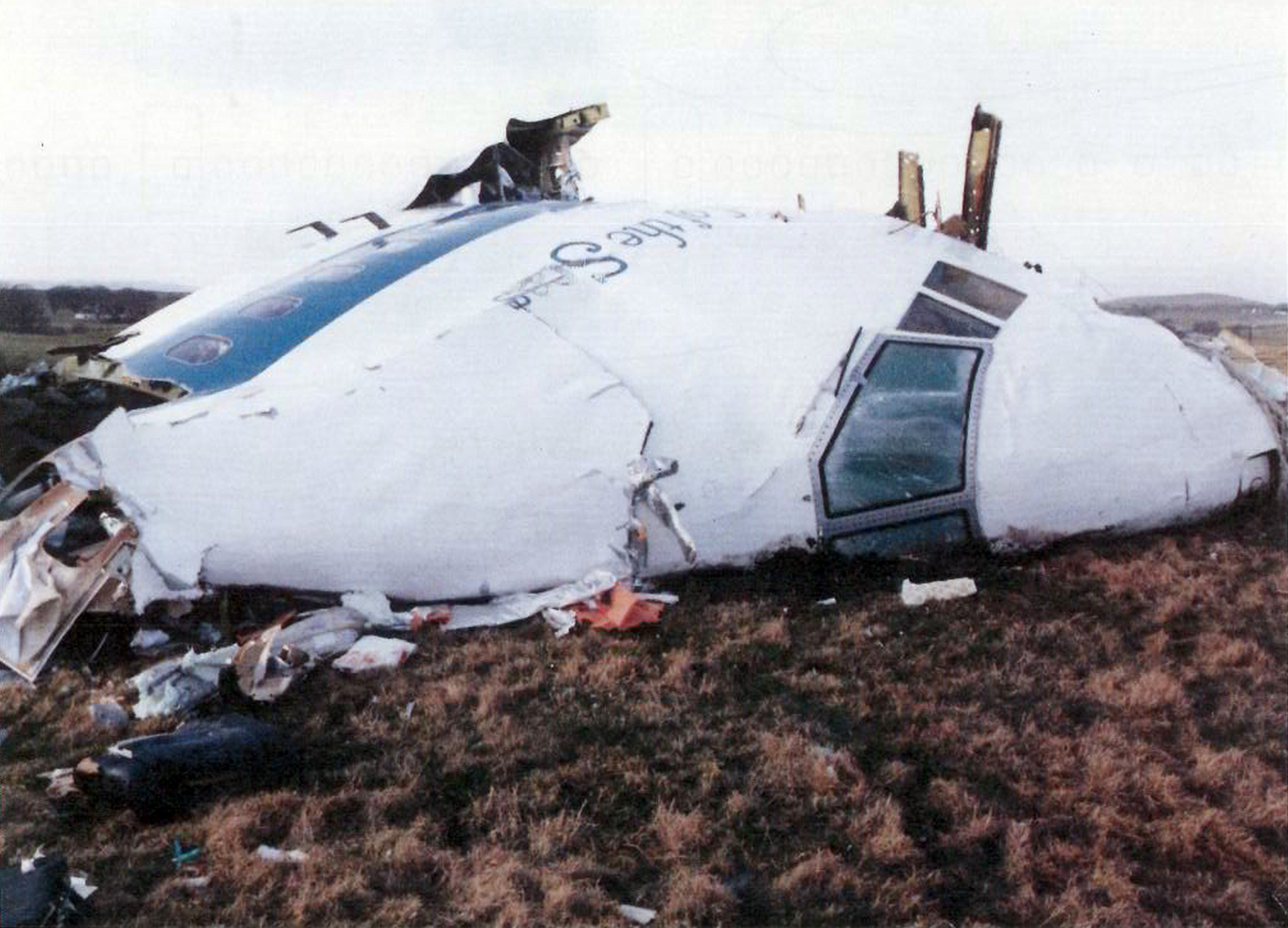
Photo: Nose and flight-deck wreckage of Pan Am Flight 103 near Lockerbie. Air Accidents Investigation Branch, Report 2/1990, Appendix B, image B-9. Crown copyright; reproduced under the Open Government Licence v2.0, via Wikimedia Commons.
This article examines the Lockerbie prosecution immediately before the August 24, 2026 postponement. A subsequent update below records the delay.
Nearly 38 years after the destruction of Pan Am Flight 103, Abu Agila Mohammad Mas’ud Kheir Al-Marimi was approaching a federal trial in Washington, D.C. The planned proceedings would put the bombing before an American jury for the first time. Mas’ud had pleaded not guilty; the accusations against him remained unproved in his U.S. case.
The attack and the prosecution’s allegations
On December 21, 1988, the New York-bound aircraft was destroyed over Lockerbie, Scotland. All 259 people aboard and 11 people on the ground died, including 190 Americans. U.S. authorities announced charges against Mas’ud in December 2020 and confirmed his arrival in American custody in December 2022.
Prosecutors allege that Mas’ud, a former technical specialist in Libya’s intelligence service, assembled the explosive device and helped carry out the operation. Their account links him to a suitcase bomb introduced into the baggage system in Malta. Those are the government’s allegations, not findings against Mas’ud by a trial jury. The original prosecution included aircraft-destruction charges and an explosives charge concerning a vehicle used in foreign commerce.
A disputed statement at the centre of the case
A statement attributed to Mas’ud during a 2012 interrogation in Libya became a major pretrial dispute. His lawyers argued that coercion made it unreliable; the interviewing officer disputed that account. STV’s pretrial reporting said Judge Dabney Friedrich had ruled in early August that prosecutors could introduce the statement. Admission into evidence does not itself establish that a statement is true or that a defendant is guilty.
The proceedings had already been pushed back from May 2025 and April 2026. The volume of material requiring review and Mas’ud’s health complicated preparations. By late August, the immediate question was whether a jury would finally hear the competing accounts.
What the trial would decide
The case concerns Mas’ud’s individual criminal responsibility. It is separate from the Scottish proceedings that convicted Abdelbaset al-Megrahi in 2001 and acquitted Lamin Fhimah. A possible life sentence must also be distinguished from an imposed punishment: before the postponement, Mas’ud had no conviction or sentence in this U.S. prosecution.
What happened next
On August 24, Friedrich postponed the trial so the defence could investigate newly discovered evidence, including material located abroad. Reuters reported that jury selection had been scheduled for August 26 and that no replacement trial date was set in that decision. The postponement neither dismissed the charges nor resolved the disputed evidence.
Read Mas’ud’s NPPC profile and case record.